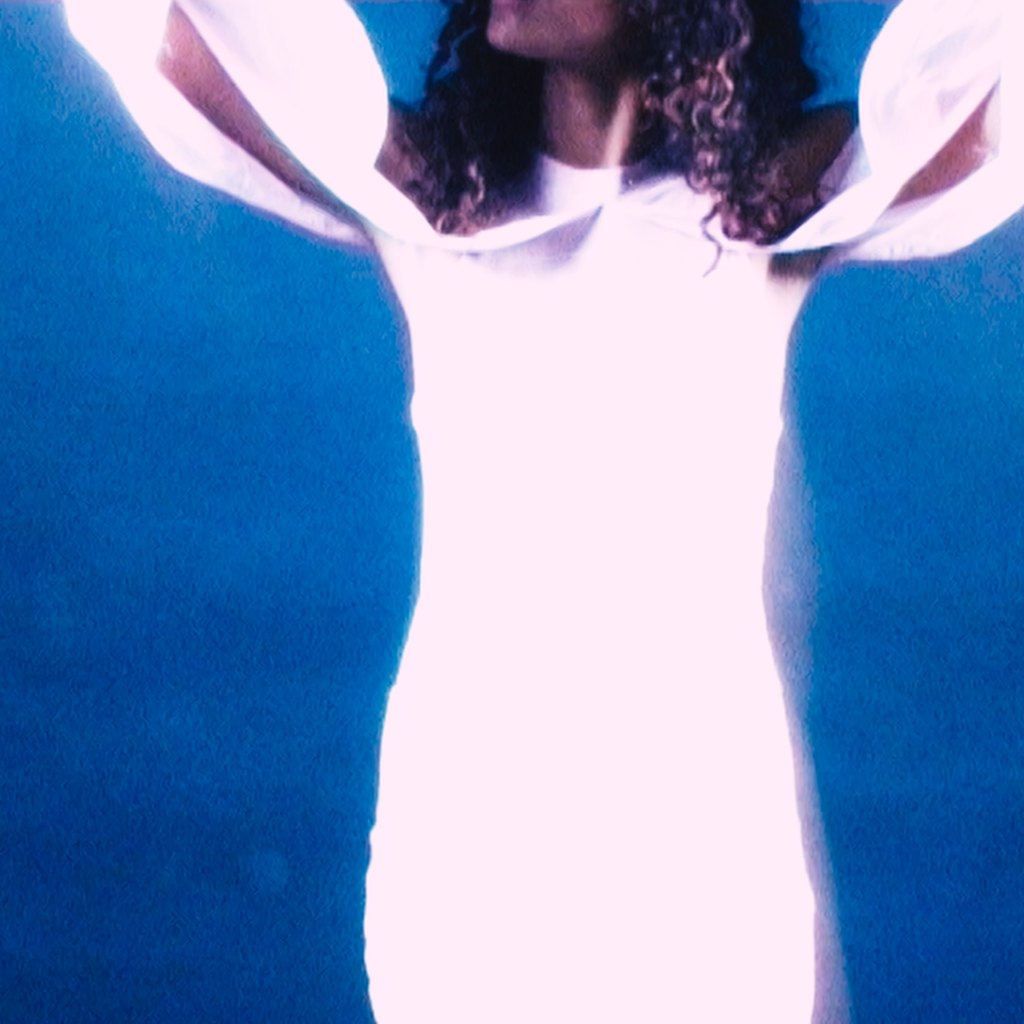
Words by Skylar Sanders
There’s something otherworldly about ELLIE’s Invisible Things. Across five tracks, the EP seems to follow a deliberate narrative arc, though one that leaves plenty of room for interpretation. Its spiritually charged language, references to Christian mythology, and folkloric soundscapes suggest a story of divine origin and earthly disillusionment. It feels like a progression through the stages of grief told from the perspective of an ethereal being not born of this world, whose existence becomes transformed upon its descent into the human realm.
Sonically, Invisible Things could fit neatly between Enya and the Cocteau Twins on your playlist, with an enveloping, almost weightless quality that makes its more grounded moments all the more striking. It’s a record concerned with, of course, the invisible things that give life meaning – whether that means faith, belonging, or the promise of something beyond the veil.
The EP opens with “In the Breach,” a kind of mystical birth. “Once you were born / In honey and meat / Gloves made of silk / Your eyes on gold,” ELLIE croons over playful, trance-like vocalizations and a spiraling soundscape. Its layered textures create the sensation of a slow descent into something intangible, as though we’re witnessing the formation of a world that exists just beyond the boundaries of our own.
Just after the one-minute mark, the track briefly falls into stillness before ELLIE introduces two particularly loaded declarations: “Babylon was born / Jesus Christ will rise.” The sudden appearance of such explicit religious imagery against an otherwise New Agey backdrop establishes a spiritual undercurrent that persists throughout the record. Whether the references are intended to invoke Christian mysticism, biblical prophecy, or something more abstract, is difficult to pin down. That ambiguity, however, is part of the appeal – the track feels less like an in-your-face religious statement than an invitation into a mythology of its own.
If “In the Breach” is the descent itself, “Heaven” feels more like the moment immediately after, when the world finally comes into focus. It’s comparatively stripped down, with an absolutely gorgeous arrangement that calls in delicate plucking and an almost folkloric sensibility that makes the track feel like a reflecting pool. There’s a weightless quality to it, as though we’re watching (or, more accurately, hearing) something fall in slow motion.
“Heaven’s not a home for strangers / Who claim to be owners / Of a land they do not have the keys,” ELLIE sings, introducing a more pointed political dimension to the project’s spiritual preoccupations. Her conception of heaven is one that cannot be owned, gated, or earned through some arbitrary measure of who deserves what, or why. The language of ownership and access feels particularly deliberate, especially in a world in which belonging is often treated as something that must be granted by those in positions of power. “Heaven’s doors,” she suggests, aren’t meant to be knocked on, but crossed. It is “not deserved but given / For free.”
“There’s no tomorrow to go to / Without wings on your back / To fly out of your cage,” she continues, complicating the idea of heaven as a fixed destination. Is this the story of an angel leaving heaven, escaping the cage of blissful ignorance that comes with being freely gifted a perfect world? Or is the cage something more earthly, a structure that keeps us from recognizing the freedom we were promised in the first place? Either way, the track begins to suggest that the descent is a necessary part of this angelic twist on the hero’s journey. Its beauty is melancholic, as though she’s already beginning to understand what it means to leave heaven behind.
That understanding arrives with considerably less grace in “Here Down on Earth.” This track introduces a more grounded rhythmic structure, with percussion that anchors it in a way its predecessors avoided – and the effect is jarring. “Have you heard the news here? / Here down on earth / Weepings and gnashings of teeth / Here down on earth,” ELLIE questions, invoking biblical imagery once again against the increasingly stark realities of human existence. Allusions to violence emerge against the previously ethereal worldbuilding, with lines like, “Wake up soldier / Where’s your weapon?” offering an unsettling introduction to the world below.
There’s a sense of confusion here, perhaps even betrayal. “Where’s my heaven? / Father god / My bread’s rotten / Here on earth,” ELLIE continues, sounding like a fallen believer trying to reconcile the world she’s entered with the one she’s been promised. The divine seems to have disappeared somewhere between descent and arrival, leaving behind a world that feels fundamentally at odds with everything she once knew and loved. There’s an almost transactional quality to her relationship with faith here, as she offers devotion and faith and hope in exchange for the possibility of rediscovery of heaven in the human realm.
By the time we get to “On My Own,” ELLIE’s initial shock has faded, giving way to something more devastating: adjustment and assimilation. Lines like, “All they talk about is love but / Lovely days aren’t for us, my dear,” allude to a growing distance from heaven. The repeated declaration of “On my own” reads as a self-assuring mantra, a way of making peace with her crumbling idea of what this world would be like.
If we’re still following the perspective of some fallen angel, this is the point at which immersion on earth begins to really take its toll; Love may be everywhere in theory, but its promises have done little to make earthly life feel less isolating. ELLIE seems to be releasing her earlier idealism, reckoning with the loneliness of being human. It’s difficult to tell whether she’s accepting her new role on earth, or trying to convince herself she can survive without a divine presence. Maybe those two things aren’t mutually exclusive?
The closing track, “Priére á Mon Ami,” which translates to “Prayer to My Friend,” brings us back to the spiritual language she opened the project with, though her relationship with her faith has transformed massively. Even the reference to a fortress around her heart feels like a callback to the protective, mythical imagery of “In the Breach”: “Lips of gold can’t be stained by man lies / When you say I will, I will say I trust / Fortress on my heart, you break it all.” The track seems to be more concerned with what remains of her relationship with the divine after it’s been tested.
“You promised I wouldn’t be alone,” ELLIE croons as she grapples with being on her own and attempting to restore the faith she previously seemed to believe was broken beyond repair. “Where I put my feet, you conquer my fear / Come to me / No more silence,” she continues. It feels like ELLIE’s attempt to hear the divine through the noise of earthly existence, a search for some trace of the heaven she left behind. The production suddenly introduces heavier, more metallic elements, building toward a finale that feels less like a return to safety than a leap of faith. After all, what else can she do but surrender?
The most interesting thing about Invisible Things is that its final return to faith doesn’t negate the experience of having lived through the trials and tribulations that accompanied it. ELLIE has already encountered the world, immersed herself in it, experienced its violence and loneliness, come to terms with the limitations of heaven, and all the rest. Whatever she finds in the end, though, she approaches it differently. It’s a gorgeous, somewhat haunting, conclusion to an EP that understands faith less as a destination than as a continual, lifelong journey that we choose to embark on.