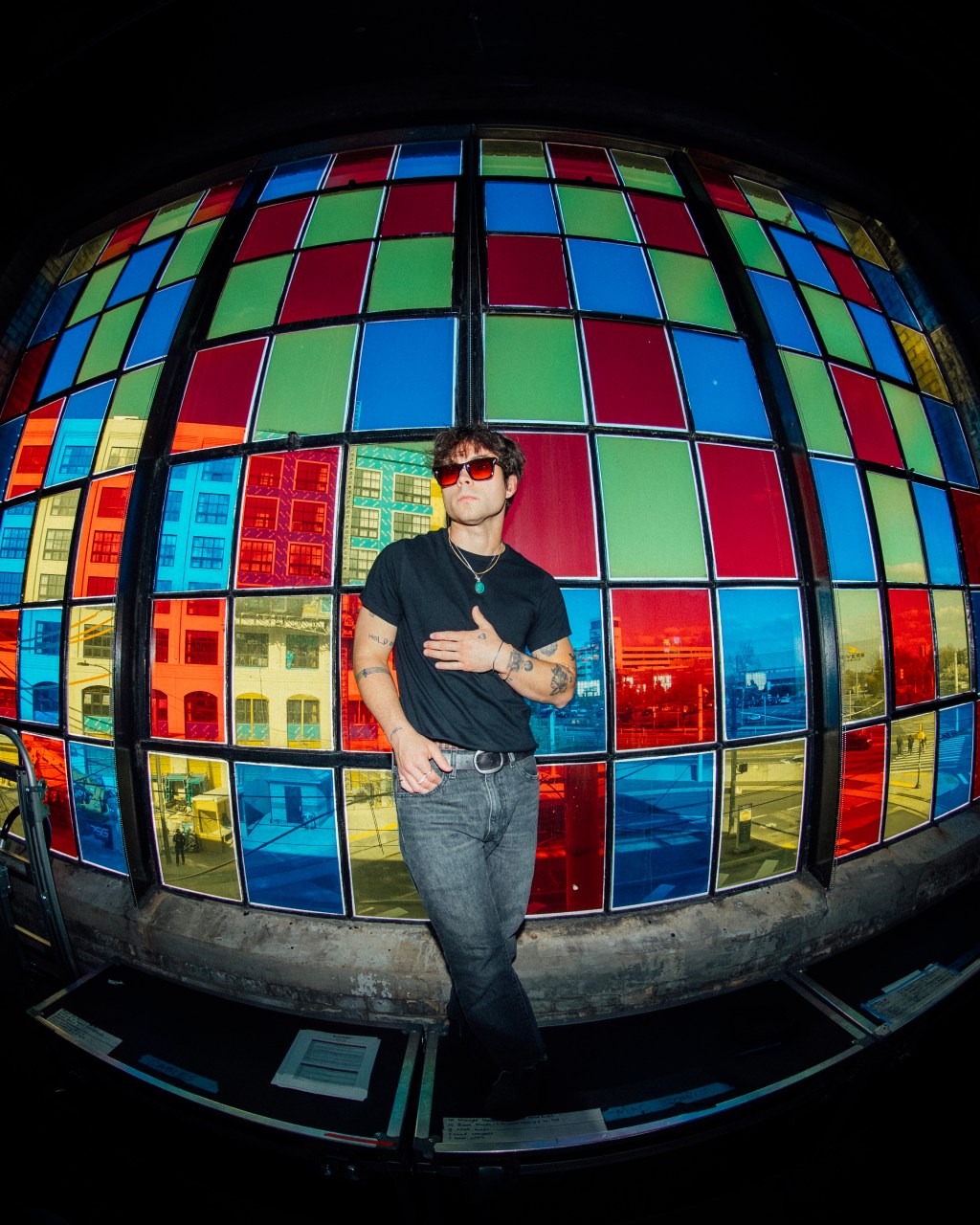
Interview by Katherine Cardinale
Breakout pop rock artist kylekelly’s debut EP, a melancholic romcom, is out today, and we were lucky enough to have been able to sit down and chat with him ahead of his opening set at Irving Plaza earlier this spring to discuss his influences, challenges, and growth as a musician. The EP features Gen-Z pop punk anthems inspired by romcoms and about personal experiences with mental health and vices. You can stream a melancholic romcom wherever you get your music now and read on to learn more about kylekelly!
LOUDSPEAKER COLLECTIVE: “It always ends the same” kicks off your EP with such a cinematic vibe. Can you tell us more about what inspired it and how you approached turning it into a pop rock anthem?
KYLEKELLY: The first thing I had was the post chorus. We had a whole production laid out and then I had the post chorus. I’m the type of writer where when I have one specific line, I know the song is about. When I had the one specific line, I didn’t want to write it because I knew what it was about, so it took me about a year to admit my guilt for something I’m really not proud of that I thought would make me feel better in the long run. And like the song says, it never does, so it turned into that, but we had the production and I kind of mapped it out and the way it worked is that it became our cry in the club sort of song. I wanted something that grooved, and I like to have sad lyrics and happy music. And so it just worked out really well.
LOUDSPEAKER COLLECTIVE: Your EP, a melancholic romcom, was influenced by classic ‘90s rom coms like 10 Things I Hate About You and She’s All That. What drew you to that genre of storytelling, and how did it shape your creative process?
KYLEKELLY: In all honesty, I just got a free Paramount+ subscription from Delta, and I had never seen How to Lose A Guy In 10 Days. And She’s All That was also on there, which I’d never seen. And I wound up watching She’s All That, I think, like, nine times in a row. I kind of fell in love with Laney Boggs real hard, but I kind of just fell into that and then started re-watching all the ones I had seen, like Crazy, Stupid, Love., 10 Things I Hate About You, That Awkward Moment… and then it became an inspiration less as I was watching them and more while we were writing. And the whole EP is written in retrospect, so it worked out that it kind of was second nature. And then by the time we had finished the writing cycle, I was like, “Oh, we just wrote every plot point in rom com.”
LOUDSPEAKER COLLECTIVE: There’s a really honest, vulnerable tone throughout your EP — especially around themes like anxiety, heartbreak, and self-sabotage. Were there any songs that felt particularly cathartic or difficult to write?
KYLEKELLY: I mean, “it always ends the same” took, like, a year to make. “OMG” was really cathartic. I would argue it’s one of my most vulnerable songs, because no one wants to admit that, years after a breakup, you’re still thinking about the other person. So I think “OMG” did take me a while. It kind of just fell out of me. But I’d call it the most cathartic. And “what if I never get over you’ is one of the new ones from the EP. That one hit hard once it was done. I wrote it with someone I just met in Nashville and we weren’t thinking about anything in particular. And then he came up with the tag, and it was a thought that I had after a really long relationship that ended a few years ago. After such a long term relationship, you have that thought. And when we wrote it, it became super cathartic for me, because I was like, “Oh, I’ve never written about this. Now people have to hear that I have this thought.”
LOUDSPEAKER COLLECTIVE: For sure. I feel like putting yourself out there can definitely be very daunting and hard.
KYLEKELLY: Exactly, especially when it’s been years. And like, they have a new partner. I have, you know, I have to deal with that. Yeah, that’s definitely difficult.
LOUDSPEAKER COLLECTIVE: You’re a self-taught multi-instrumentalist and started playing shows in NYC as a teenager. How do those roots show up in your present-day music?
KYLEKELLY: I’d never played a band show, so this is very new for me, but I think the showmanship and the stage presence was kind of natural from day one. I have a much better sense of how to bounce back and how to not let a mistake “ruin” the show. When people make a mistake, they’ll be like, “I’m sorry. Let me start over.” Don’t do that. Just keep going. In Chicago the other night, the entire intro got dewritten. Like, the whole track got messed up. The click was wrong. And instead of sitting there and being like, “Sorry guys,” I picked up my guitar and I was about to do the whole thing acoustic. And the feedback I got was that it was insane for me to know what to do just off the bat without freaking out or something while being on my first tour. So I think it’s that keen sense of how to put on a show without having put on a show prior to this tour. Stuff like that.
LOUDSPEAKER COLLECTIVE: That makes sense. And I definitely think that’s very professional. It’s really hard to just go off the bat. Like, as I do this more, I learn that putting on a show is very chaotic. It’s a lot more complicated than just scanning your ticket, walking in, and then everything being ready to go for you.
KYLEKELLY: There’s tracks, there’s rehearsal, and, like, the thing that happened in Chicago is stupid technical. We have a click track in our ears and the click track got messed up. The click was going at a wrong speed at the tracks, so my drummer was going at a different speed, and my guitarist was going at a different speed, and it was the most mind numbing thing I’d ever experienced. And you’re standing in front of seven, 800 people, and they’re all like, what?
LOUDSPEAKER COLLECTIVE: You worked with some collaborators like Jeffrey David and Brandon Paddock. What was the collaborative process like and how did they help bring your creative vision to life?
KYLEKELLY: Jeffrey’s actually my manager too, and it really helped to have an already established relationship. Brandon is mind-numbingly genius and so quick when it comes to everything. I’d never met him prior to producing the album, and I was a little bit skeptical, because I like to keep my circle tight. And when I met him, it helped that he and I are the exact same person. I would have an idea and he would know exactly what I was talking about. And now I go to him for everything. He’s done every cover that we’ve played. It’s really worked out in a cool way, especially because he can do things that I can imagine but can’t do myself. And I have this thing where I say “trust the process” with him because I’ll walk in the studio and be like, “TTP, I’m gonna let you do your thing.” When we got the tracks back for the show there were layers that I don’t even remember him doing, and it was just the coolest experience to have.
LOUDSPEAKER COLLECTIVE: There’s something very Gen Z about your lyrical voice — it’s witty, self-aware, and emotionally raw all at once. How intentional is that tone, and who are some artists that have shaped this approach?
KYLEKELLY: It’s incredibly intentional. Thats why it takes me so long to write. Lyrics are my live and die. I don’t let anyone touch them. If people give me a lyric, I need to really like it, and sometimes I’ll change it after the fact that. The inner Virgo in me is very manipulative, so I want people to get what I’m trying to say as accurately as possible without being on the nose too. Because I hate it when people are like, “I was in a relationship, and it sucked.” Be a little bit more interesting! I think the lyricism of artists like The 1975 or Luke Hemmings or U2 to some degree. People like that really shaped me and helped explain the difference between literal and abstract and meeting in the middle. I’m not as metaphorical as I’d like to be, but I’m not literal. And I try to just do that in a way where people get what I’m trying to say, as pretentious and meta as it probably comes out.
LOUDSPEAKER COLLECTIVE: How did you decide which songs made it onto your recent EP, and how do they all fit into the larger artistic world that you’re creating?
KYLEKELLY: It was actually really easy. I think “my little heart” was the last song I wrote during the writing cycle, and it was the second song we recorded. The moment we finished it that day, I knew it was the debut and was like, “This feels like me in a nutshell.” Then it was like, “Okay, what do we feel like comes next?” And the natural one was “HOW IS THIS GONNA END?” because of the election cycle. “Priscilla” was a bit of a battle. I wanted “what if I never get over you” to come out. Jeffrey wanted “Priscilla” to come out. I lost. But it was kind of just that process of building out the singles one by one and being like, okay, what do we think should come next? Then when we booked the tour, actually, we had landed on a place where we were originally gonna do all singles, but now this is happening. We originally thought about wrapping it up into… one piece… — sorry, I almost let that slip! — into one singular piece, yeah, it kind of just fit together. And the two songs that are coming out with the EP that weren’t singles just felt the best to tack on as plot points to the overall project we’re coming up with. Gosh, it kind of just fit the puzzle piece.
LOUDSPEAKER COLLECTIVE: You’ve been open about subjects like mental health in your work. Has creating music helped you process those experiences?
KYLEKELLY: It definitely helps to process them. I don’t like processing them, but it helps. It was really hard to confront a lot of the things that I confronted. And I think it in some ways, I would say that 95% of the things on the EP are all written in retrospect, which in itself is a bit of a cop out and a defense mechanism, because I’m like, “Oh, I’ve already processed this. It’s been years. Now I can write about it.” And I’m starting to unlearn that habit. I think for me it’s more of an, “I don’t feel like people talk about the things that I’m talking about enough for my personal taste,” so I wanted to be able to have something even just for myself and talk about those things in a way that I feel comfortable doing so. And that gives people a reason to stop asking me about it. Listen to the song! Don’t ask me anymore!
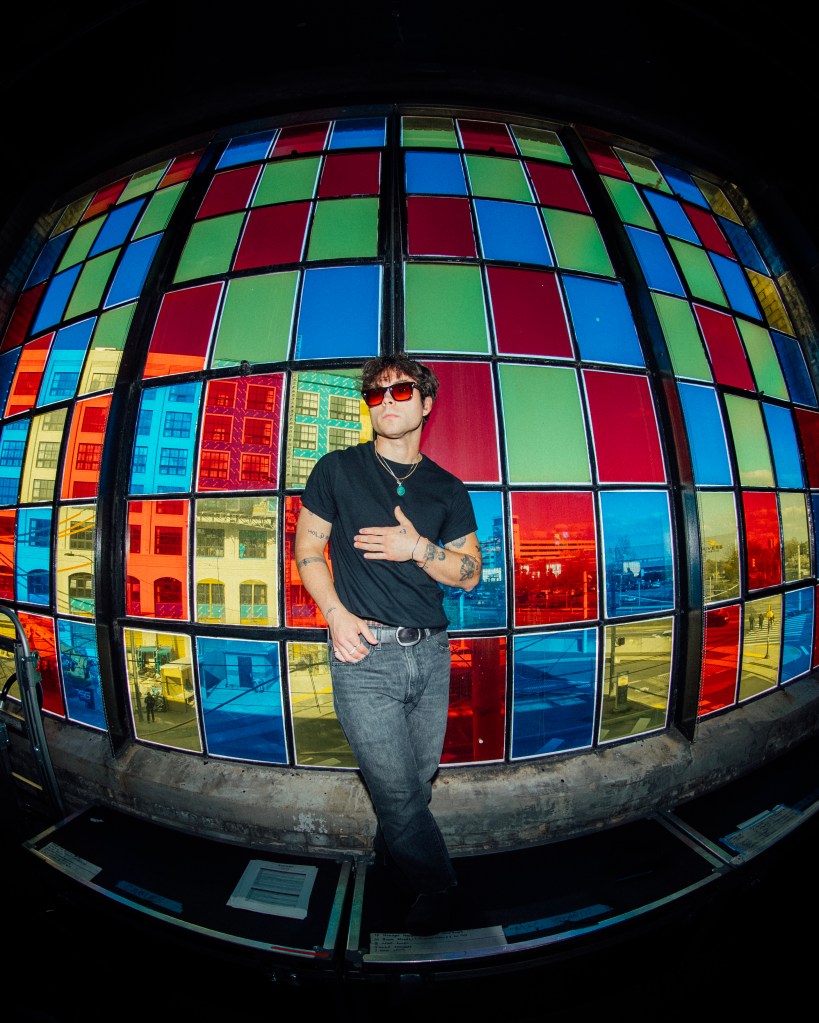
Photo by Ashley Crichton
 Loudspeaker Collective